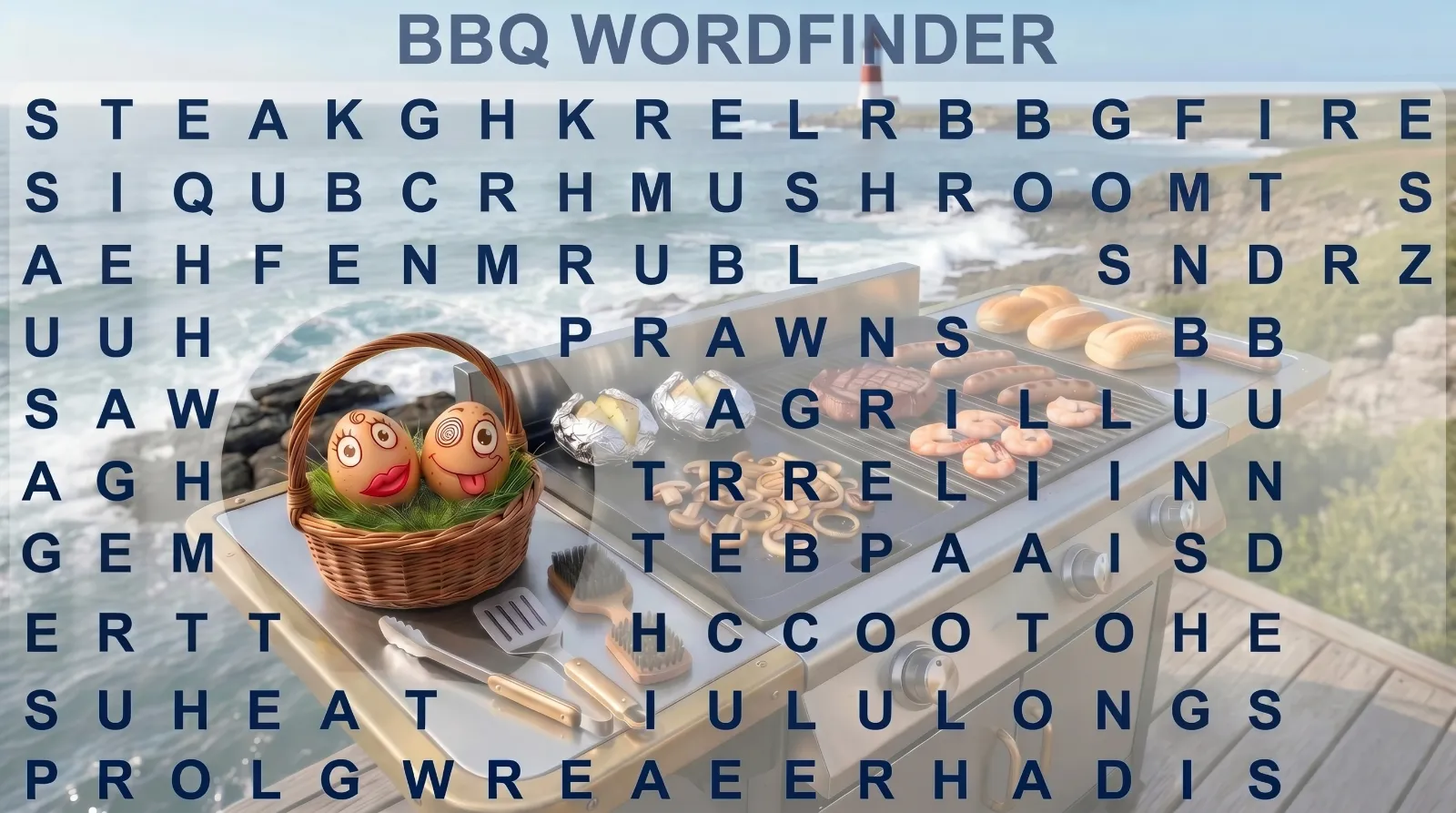
Word BBQ, anyone?
Let’s fire up some tricky vocabulary.
Vocabulary can burn people up. It’s simple: you don’t understand what someone is saying; you don’t understand what they mean; you don’t understand the combinations of words being used — and suddenly comprehension is gone. Looking for the right words to express yourself is another pot on the stove entirely.
What’s the worst? When you hear all the words, you recognise all the words, and yet you still don’t understand. It’s like: How did those words go off into that other context? I’m lost. The result is a steamy frustration — usually directed at yourself.
A Dutch Phrasal Verb That Left Me Gobsmacked
One day in Holland, someone said to me:
“Hij gaat ervan uit dat…”
I understood every single word. Yet the meaning? Nothing. I even asked for it to be written down. Still nothing.
“He goes there from out that…” It made no sense.
Eventually, a colleague with some English explained it:
“He proposes / he suggests that…”
It’s actually a bit more like, “He assumes or presumes that…” Nevertheless, I had stumbled across a Dutch phrasal verb — a combination where the literal meaning collapses and the conceptual meaning takes over.
This is the essence of phrasal verbs: not logical literal connection, but lateral conceptualisation.
“He predicts or envisions a possible direction extending from current circumstances…”
Once you see it, it makes sense. Until then, it’s a brain‑twister.
So Let’s Get to the BBQ and Grill
More advanced speakers — or those used to communicating with native speakers — have a well‑stocked pantry of expressions and combinations. Beginners, by comparison, often feel half‑starved.
Phrasal verbs can be real mental knots.
What Is a Phrasal Verb?
The Chambers English Dictionary of Phrasal Verbs defines it as:
“A short two‑word (or sometimes three‑word) phrase made up of a verb, such as get, give, make, pull and see, and an adverb (an adverbial particle) or a preposition, such as in, off, on, out and up.”
Simple ingredients. Simple words. So why do they cause so much trouble?
Why the Brain Runs Out of Firewood
Teachers say, “Look it up in your dictionary.”
So you do.
Look it up. Easy, right?
Except… “look” = with your eyes “up” = direction toward the sky
What does this have to do with searching for a word?
This is where phrasal verbs feel like madness — but there is logic in the madness.
Years ago, standing in the middle of Dam Square in Amsterdam, I realised something important: native speakers don’t think of phrasal verbs as combinations. They think of them as single units of meaning.
Learners, however, see two separate words and try to glue them together literally.
That’s where the firewood runs out.
Bread and Butter Vocabulary: The Essentials
Different methods exist for calculating the top spoken words in English — whether internationally or within specific regions like the US. International English has a very different top word compared to American English, where “I” ranks number one.
Spoken and written vocabulary also diverge depending on:
- internet‑based corpora
- newspapers and magazines
- academic texts
- conversational transcripts
Some theorists say you need 500 words to communicate. Others say 1000, 1500, or more.
The higher the number, the easier it becomes to read — with all the decorative embellishments, the parsley sprig on the cream dollop, the finishing touch before serving your steaming bowl of pumpkin soup.
Phrasal verbs sit right in the middle of this vocabulary landscape: essential, common, deceptively simple, and absolutely maddening.
Conclusion
Phrasal verbs are the BBQ of English vocabulary — short, hot, and capable of burning you if you’re not paying attention. Their ingredients look simple, yet their meanings often leap sideways into conceptual territory. Once you learn to see them as single units of meaning rather than literal combinations, the smoke clears and the flavour becomes enjoyable.
Till next time,
Leonie