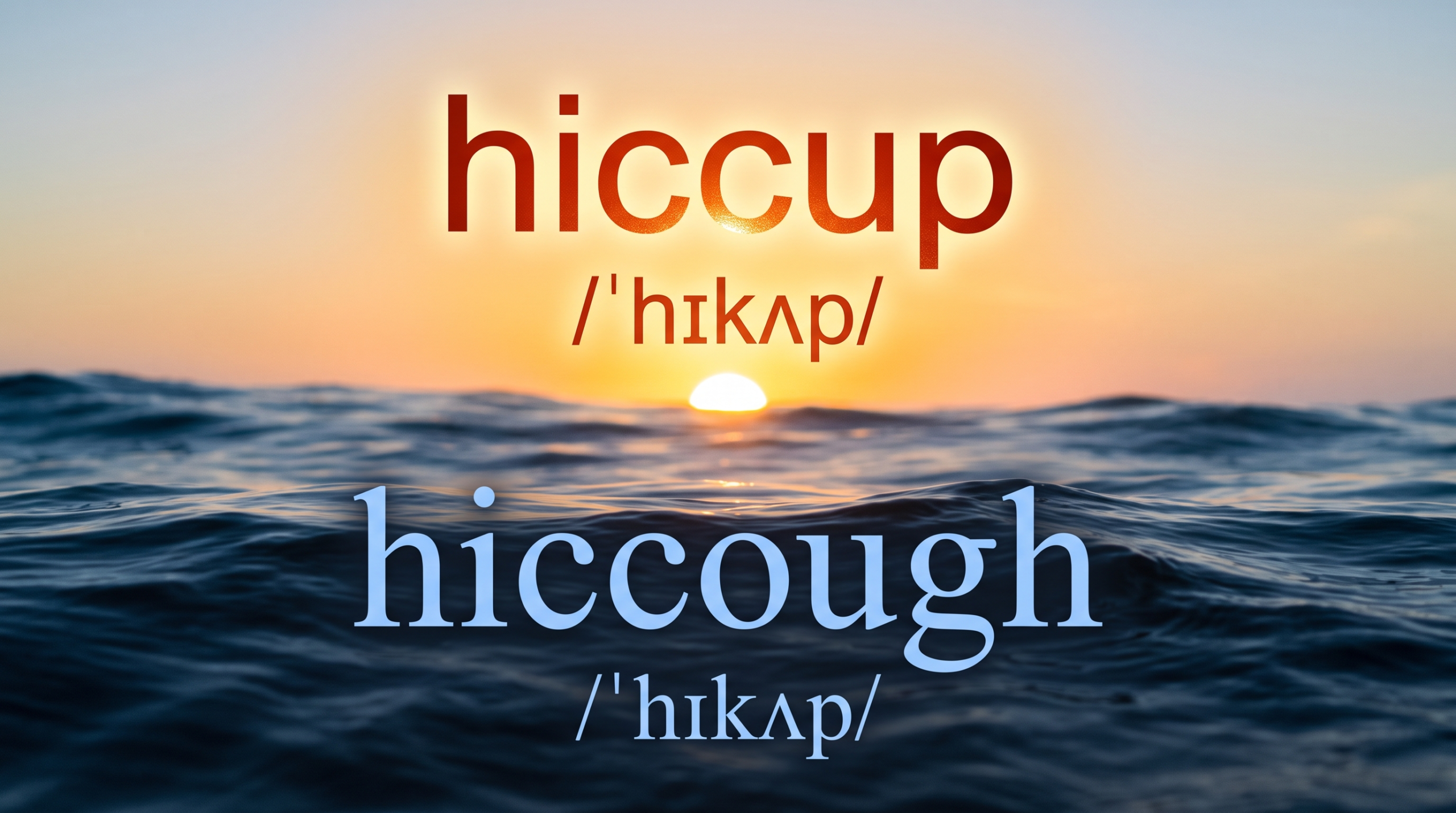
— When Language Shows Its Living Pulse
The Moment of Correction
It started, as these things often do, with a tiny interruption. A message came through, someone corrected my spelling — hiccough — and suddenly I found myself staring at a word I’ve used my entire life. A word printed in my 1994 and 1999 dictionaries as a perfectly acceptable alternative. A word that, apparently, the modern online dictionary now calls “an error”.
An error?
After centuries of use?
After being the “proper” British spelling for generations?
It was a linguistic hiccup in the truest sense: a small jolt that revealed something much bigger.
Language moves.
Dictionaries move with it.
And sometimes the speaker is more historically correct than the dictionary.
The Sound Before the Spelling
Before English got tangled in its own spelling habits, the word began simply as sound.
Early forms included:
- hickop
- hicket
- hyckock
All onomatopoeic.
All attempts to capture the involuntary noise of the body.
There was no connection to cough.
No shared root.
No etymological logic.
Just humans doing what humans do: naming a thing by the sound it makes.
This is the first clue that language is not born from rules — it is born from experience.
The Folk‑Etymology Detour
Then came the 17th century, when English writers decided that the -cock ending looked suspiciously like cough.
And so hiccough was born — not from history, but from assumption.
It became fashionable.
It became formal.
It became British.
It became the spelling preferred in educated writing for nearly 300 years.
And yet, it was never correct in the etymological sense.
This is where the humour creeps in: my printed dictionaries still list hiccough as a valid alternative, while modern online dictionaries now declare it “wrong”.
Apparently my 1994 dictionary didn’t get the memo.
The Modern Shift — And the Comedy of ‘Correctness’
From the late 20th century onward, lexicographers quietly reversed course.
- Hiccup resurged.
- Hiccough started to be phased out.
- Usage data showed overwhelming preference for the phonetic spelling.
- Dictionaries followed suit.
- Some now label hiccough as “an error”.
Meanwhile, American English had been using hiccup all along — part of its broader tendency to simplify spellings (favor/favour, jail/gaol, color/colour).
So when modern sources say hiccough was “phased out in global English”, what they often mean is:
North American usage became dominant.
This is the comedy of correctness:
a spelling used for centuries can suddenly be declared “wrong”, not because the word changed — but because the dictionary did.
What This Reveals About Living Language
This single word exposes a truth that every language learner should know:
- Language evolves with its speakers.
- Dictionaries follow usage, not the other way around.
- “Correctness” is temporal, not eternal.
- Clarity often wins over tradition.
- Communication is functional, adaptive, and human.
When learners understand that language is alive, they can stop fearing mistakes and start focusing on meaning, tone, and connection.
This is the heart of authentic functional language — not the institutional version, but the lived one.
Cross‑Language Confusion: When Sound Outruns Meaning
The hiccough/hiccup story isn’t unique. Languages constantly trick us with sound‑based illusions.
Take this cluster:
- mace — the spice
- maïs — French for corn
- maíz — Spanish for corn
- maize — English/Dutch spelling for corn
They look related.
They sound related.
But not all of them are.
The sound overlap creates semantic interference — even for multilingual speakers. It’s the same phenomenon that produced hiccough: the human tendency to map unfamiliar words onto familiar shapes.
Sound is a powerful connector, but it can also mislead.
Cross‑Language Clarity: When Roots Reveal Connection
And then there are the words that do the opposite — words that illuminate meaning across languages.
Consider:
- justice (English) → /ˈdʒʌstɪs/
- justice (French) → /ʒysˈtis/
- justicia (Spanish) → /xusˈtiθja/ or /xusˈtisja/ (Latin American)
Three languages.
Three pronunciations.
One Latin root.
The shared Latin root creates a multilingual “core meaning” with visual relativity. For pronunciation, the French flows naturally into Spanish comprehension, and English sits beside them like a cousin with the same surname.
Here, etymology becomes a bridge rather than a trap — a phonemic pathway learners can hear, letter combinations they can read, or both.
The Intercommunication Effect — Etymology in Real Time
Languages influence each other constantly.
Words migrate, mutate, collide, and sometimes collapse into new forms.
Etymology helps us understand these movements:
- how meanings shift
- how spellings drift
- how cultures borrow and reshape each other’s words
- how learners interpret (or misinterpret) across languages
- how changes happen quietly, in real time
The hiccough → hiccup shift is not an anomaly — it is a perfect example of language evolving under our feet.
Understanding this makes learners more adaptable, intuitive, and confident.
The Hiccup That Started It All
A word I learned as a child, used my whole life, suddenly demonstrated the living nature of language itself.
This tiny correction became the spark for a much larger exploration:
how words travel, how meanings shift, how languages intercommunicate, and how etymology helps us navigate the beautiful, chaotic, multilingual world we live in.
And so the grill on etymology begins — with a hiccup.